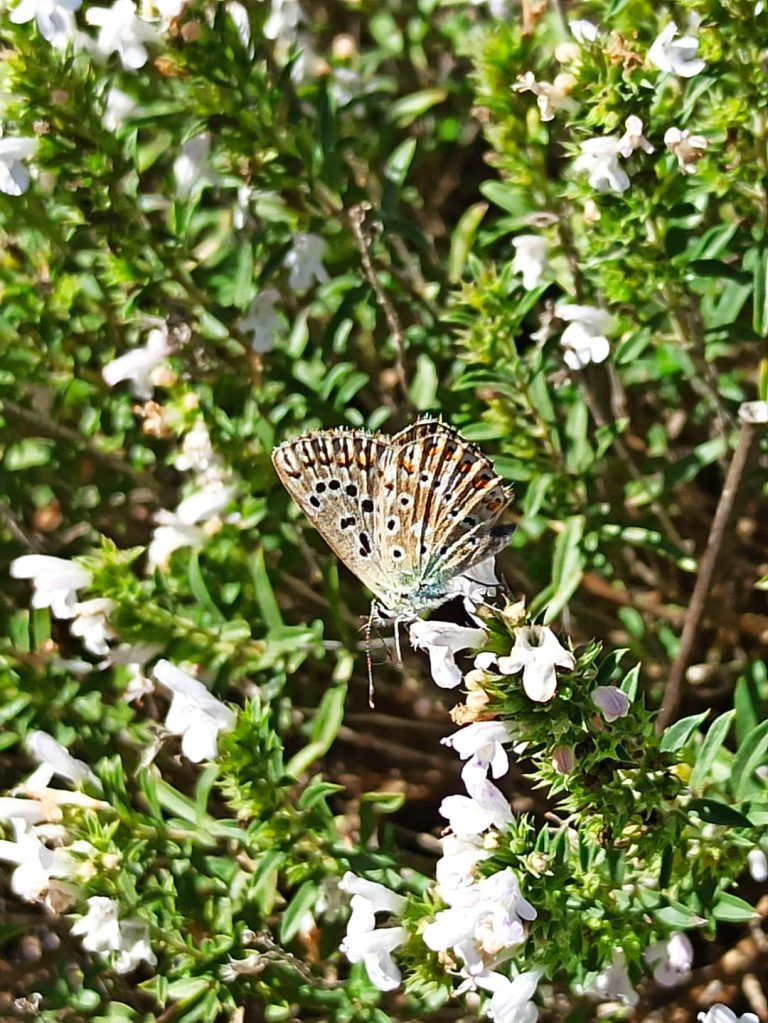
There comes a moment each summer in Provence when the landscape simply surrenders to the heat. The green exuberance of Spring has passed and grasses that only weeks before were green and supple have now become pale and brittle. Flowers have faded, seeds have formed and many plants have completed their short growth cycle that is typical of our mountainous region. The landscape changes its palette with vibrant greens giving way to ochre, silver and gold as the sun bakes, the earth hardens and drought deepens.
This summer has been particularly hot and dry, and perhaps because of this, I have been paying more attention than usual to what vegetation remains. And there, among the dried grasses, forest edges, riverside spaces and leafy glades, I find sweet Prunella vulgaris still blooming with her cooling pops of violet against the sun-baked earth.
Prunella’s small flower heads are close to the ground and are quite inconspicuous. She is easy to overlook earlier in the season, dwarfed by other vegetation. Despite belonging to the same plant family (Lamiaceae) as some of the great aromatic extroverts of the plant world such as thyme, rosemary, sage, mint, lavender and savory, there is no powerful fragrance to announce her presence. With Prunella, her essential oil is a discreet and minor part of her medicinal presence.
Yet don’t be fooled into thinking she is any “less” of a medicinal herb than her fragrant cousins – An English phrase comes to mind: Prunella is “small but mighty”. And mighty indeed she is – with records of her use going back prior to the days of John Gerard and Nicholas Culpeper.
Growing and flowering while much around her has already withdrawn, I find myself wondering what it means for a plant that lives through the hot summers to have acquired, across centuries and cultures, such a profound association with coolness and regulation. And the word that comes to me is Temperance.


Temperance is often understood simply as Moderation or Restraint. But its older meaning gives other nuances. Derived through the Latin temperantia and temperare, it carries the idea of regulating, moderating, combining in due proportion and bringing something into an appropriate state.
To temper something doesn’t mean to weaken it. In cooking, we can temper a strong flavour without removing it. We can temper enthusiasm with sound judgement and we can temper anger with compassion. So to me, Temperance doesn’t mean subduing intensity, it is more to do with modulating proportion.
Another confusion with the meaning of Temperance might be Balance. Balance suggests a point of equilibrium that, once reached, might somehow be maintained. Temperance, on the other hand, is more responsive as it asks us to adjust according to circumstance.
In English, Prunella has accumulated a collection of names: self-heal, heal-all, woundwort… In France she is known as “Brunelle”, and older vernacular names include “petite consoude” and “herbe au charpentier” – the carpenter’s herb. This places Prunella not in an apothecary or physic garden but right alongside someone working with their hands, encountering daily insults. Prunella is a remarkable plant for these everyday injuries.
Ubiquitous across mainland Europe and the British Isles, spread extensively across Asia and North America and reaching into North Africa, Prunella makes herself accessible to all who know her. Her leaves can be applied to wounds, while preparations of the plant are associated with sore mouths, irritated throats and damaged tissues. European herbalists developed such confidence in her reputation that healing eventually became inseparable from her identity.
Self-heal. Note that it her name is not Healer. Prunella reminds us where healing ultimately takes place – and who is responsible. Prunella does not heal – through her Temperance, she simply helps provide the optimum conditions. She places the locus of healing exactly where it belongs: within the living organism.
A great example is in wound care for which she is renowned. Prunella reminds us that a wound heals itself. We can clean it, protect it and dress it, reduce microbial burden, manage excessive inflammation and provide conditions that favour tissue repair. But ultimately, the extraordinary choreography of healing belongs to the body itself. The body knows how to repair itself. The therapeutic task is not to over-direct the wound healing process, but to create the best circumstances in which healing can happen and let the body do the rest.
There is another tradition, thousands of kilometres from Provence, that recognised something else in this same “small but mighty” plant. In Chinese medicine, Prunella vulgaris is known as Xia Ku Cao. Her flowering or fruiting spikes are classified within Chinese medicine as cooling. She is used particularly where energetic patterns of “Heat” or “Fire” manifest through redness, irritation and swelling.
Although the concept of Heat in Traditional Chinese Medicine cannot simply be translated as inflammation in contemporary medicine, there is certainly an interesting convergence to ponder upon. European herbalists reach for Prunella for wounds, sore throats and irritated tissues. Chinese physicians use Xia Ku Cao to clear heat and disperse swellings. Contemporary investigations identify anti-inflammatory, antioxidant and wound-healing activities among Prunella’s properties, supported by constituents that include rosmarinic acid, chlorogenic acid, ursolic acid, oleanolic acid, flavonoids and polysaccharides.
So somewhere between traditional use, Chinese Medicine and contemporary research, Prunella brings a common observation: her qualities help to temper excess and help it back towards proportion. She does not quench, override or suppress – she is a living demonstration of Temperance.
Perhaps this is the lesson that Prunella offers. The appropriate response, of the appropriate magnitude, for the appropriate duration. Personalised medicine in a plant. Healing itself depends upon this continual adjustment. And perhaps it explains why her old name Self-heal feels so appropriate.
Temperance also is relevant to the way we practise Healthcare. Our instinct as therapists is understandably to help. What else can we give? What else can we do? What else can we treat? What else can we correct? What else can we add?
Yet good practice invites us to ask a very different question: What are the conditions needed so that the body is best placed to heal itself? Sometimes the best thing to do is do nothing – and to simply support from the sidelines. Refraining from intervention is not therapeutic neglect. It is therapeutic judgement that seeks the appropriate measure including:
- Proportion – the appropriate amount rather than the maximum amount.
- Regulation – the ability to adjust our response as circumstances change.
- Restraint – the wisdom to recognise when enough has been done.
- Sufficiency – the understanding that more is not necessarily better.
These qualities matter in Healthcare. We cannot always take away the diagnosis. We cannot always eliminate pain. We cannot remove every inflammatory stimulus, every loss, every source of uncertainty or stress.
But we can help the person find some coolness within the heat of their experience. A moment of relief, a reduction in unnecessary burden, a quieter nervous system, a comforting touch, a familiar aroma. Rest, choice and autonomy. The feeling of being cared for rather than treated.
None of these actions remove the circumstances in which suffering occurs but they may change the conditions within which the person experiences them.
So turning back to this “small but mighty” plant – her flowers are modest, her stature is low, her aroma is restrained. She grows amongst other vegetation almost unnoticed. Yet for centuries, people have recognised her actions to the point of giving her a very special name.
As I walk through the dry Provençal landscape this summer, perhaps that is why her small purple flowers have caught my attention, to help me reflect on the quality of Temperance. The intelligence of proportion: knowing when to act and when to refrain, when to persist and when to withdraw, when heat is necessary and when it needs cooling, when more is required and when what we already have is enough.
Perhaps this is the quiet wisdom of the small but mighty Self-heal.