Here in Provence in the late summer, when the land becomes increasingly parched and dusty, I welcome seeing the extraordinary blue globes of the most handsome Echinops.
There are two main species of this globe thistle growing wild in the mountains where I live: Echinops ritro and Echinops sphaerocephalus. I smile when I see them in garden centres, sold as ornamental plants or positioned in garden borders for their architectural form thanks their upright silver stems, prickly leaves and unmistakable spherical flower heads.
Here in the mountains, Echinops is an integral part of our wild and rugged landscape. Even from a distance, Echinops is unique and distinctive and when I spy him, the word that comes to me is Integrity.
Integrity is derived from the Latin integer: whole, complete, intact. Often linked to moral terms such as honesty or adherence to principles, there is a more fundamental sense to the word Integrity: the ability to remain whole. For me, Echinops reflects this sense. He knows where he stands, he holds the space that he occupies and his boundaries are unmistakable – something I have regularly experienced this summer as several plants have positioned their prickly selves very close to the gate to my chicken coop.
The name Echinops derives from the Greek echinos, hedgehog, and opsis, appearance. Another name for this globe thistle is indeed the blue hedgehog thistle. In French, he is called ‘oursin bleu’, (blue sea urchin). He is also known as ‘oursin de Provence’ or ‘boule azurée’.
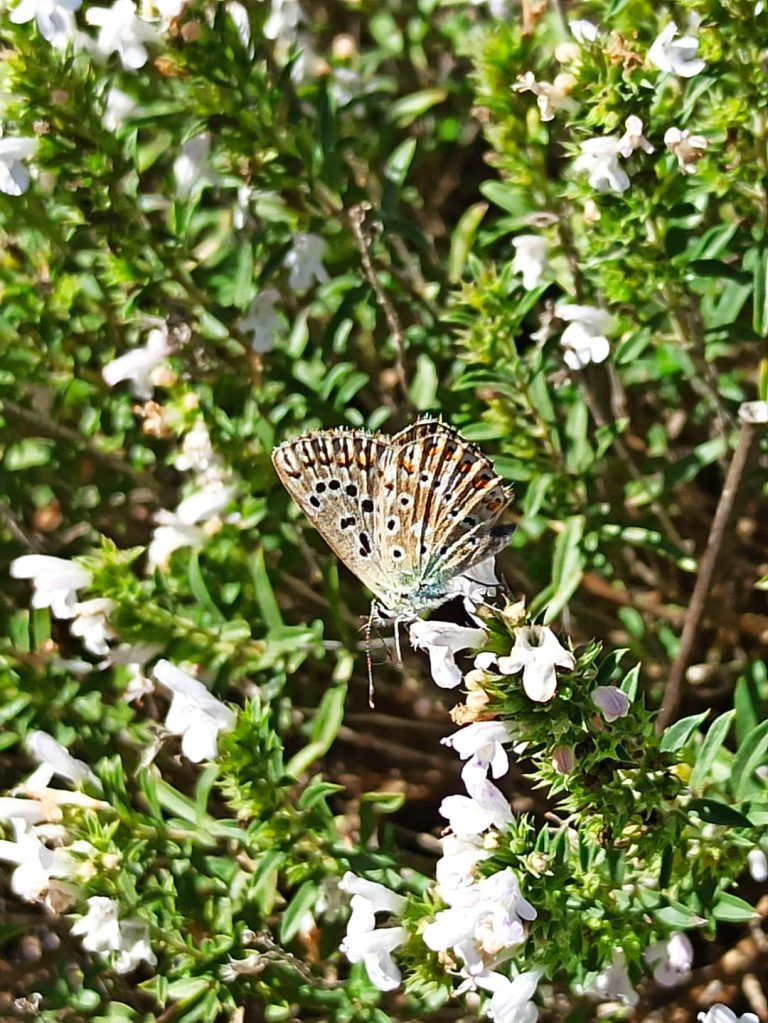
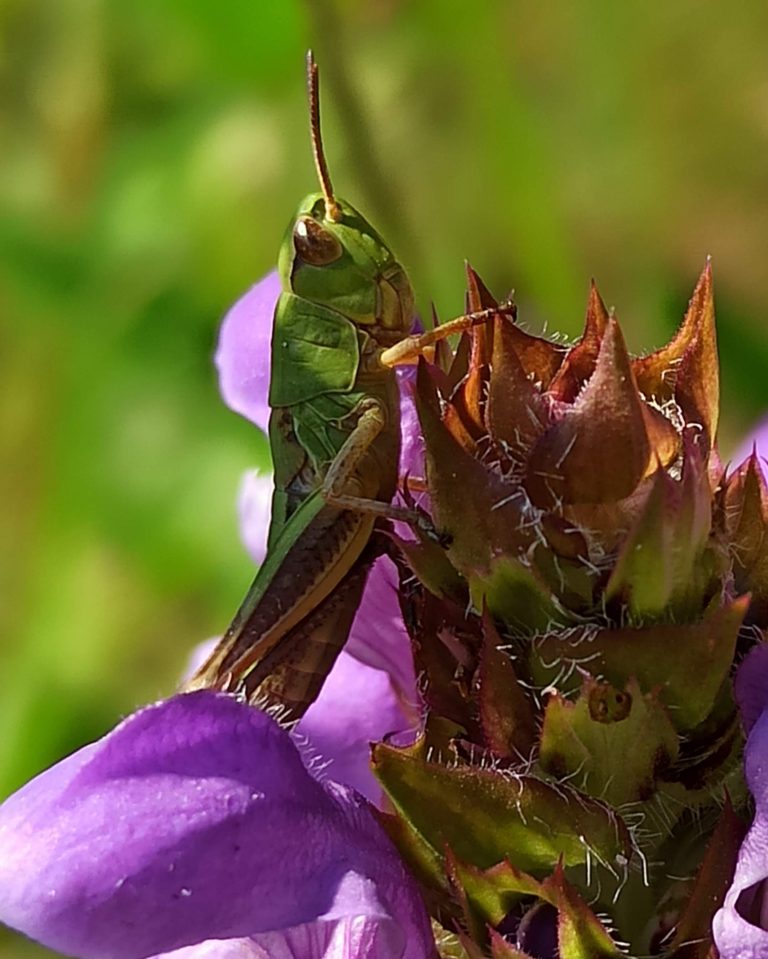
Echinops’ leaves are deeply divided and armed with spines. You cannot casually pick him – thick gloves are needed. He commands respect and clearly sets his boundaries. And yet, this heavily defended plant produces one of the most generous flowering displays of the late Provençal summer. When in bloom, Echinops is rarely alone as he generously offers pollen and nectar when other floral resources have dwindled. He is a valued resource for a large range of insects: bees, bumblebees, beetles, day-flying moths including the 6-spotted burnet moth (Zygaena filipendulae) and numerous species of butterflies.
So Echinops demonstrates Integrity by combining clear boundaries with boundless generosity. One makes the other possible and sustainable.
Echinops is a member of the Asteraceae family – what appears as a single blue ‘flower’ is actually an entire community of blooms. Each of the florets on its globes is a tiny, individual, one-flowered capitulum – hundreds of these are assembled together into each spherical flowering head. Each floret retains its own structure and identity, yet collectively, they create something far greater than they could ever achieve alone.
Integrity in a community occurs when the individuals within it are permitted and encouraged to remain themselves. When a healthy community grows with Integrity, each member has something unique and distinctive to contribute. They share a sense of purpose and belonging at the same time as retaining their individuality. And there, the blue globe that is their hub becomes a meeting place and the exchanges are rich. Echinops trades pollen, nectar and protection in exchange for pollination and genetic diversity. As a result, the community as a whole strengthens and is able to spread its influence to other spaces.


I cannot help but compare Echinops’ striking blue globe to the International Clinical Aromatherapy Network (ICAN) that has become an important part of my own professional life since its creation in 2021. In fact, one of my photos taken of an Echinops bloom was the poster child of a recent ICAN-sponsored event, The Essence of Clinical Aromatherapy International Seminar in 2023.
Like Echinops, ICAN is a global community comprised of many individuals. Our members are located across the world. They pollinate our platform with their different cultures, languages, healthcare environments, clinical experiences as well as different ways of working with aromatic plants. Each person is valued and in return for their active participation, they are gifted with the pollen of rich learning resources and nourished by the nectar of encouragement and professional connections. When their experiences converge and exchanges take place, something larger than ICAN is created. This new-found awareness, knowledge and skills are then spread around the world, much like the pollen carried by Echinops’ bees and other pollinators – and the wider clinical aromatherapy profession is thereby enriched.
There is another reason why Echinops reminds me of the ICAN community. It relates to ICAN’s own sense of Integrity. ICAN is open to join, is warm and generous, but it is not without boundaries. There is a registration process, conditions for belonging, a code of conduct and clear directions about how members interact professionally and respectfully with one another. There is clarity about what ICAN offers – and equally importantly, what it cannot. ICAN is a generous hub that thrives thanks to the individual experiences of its members and the cross-pollination of ideas, experiences and knowledge that together help us shape the very future of our profession.
Echinops offers his nectar and pollen without surrendering his architecture. His blooms are available, his pollinators are welcomed and his ecological relationships continue. And his defensive prickles remain. This is important as he is generous without erasing or diminishing his sense of identity. Boundaries are part of his Integrity. Perhaps here too, there is a lesson, especially for those of us who work in the caring professions such as aromatherapy. Many of us find boundaries difficult and, as a result, burnout is commonplace. Sustainable care does not require us to give ourselves away.
There is even more to say about Integrity and this stunning blue thistle. The genus Echinops contains an interesting and distinctive chemistry, in particular, a group of sulphur-containing compounds known as thiophenes. The roots of several species are especially rich in these compounds, and research has demonstrated a wide range of biological activities including nematocidal, allelopathic, antifungal, antimicrobial and insecticidal. I find the location of Echinops’ defensive thiophenes relevant. Above ground, his boundaries are physical and visible. Below ground, he adds a layer of necessary protection based on past experience of underground attacks from nematodes and the space invasion of other plant species.
Perhaps much of our own Integrity develops in a similar way. Above ground, people see where we stand. They witness our actions and the decisions we make, the boundaries we establish and the principles we defend. But, underpinning these visible expressions lie the unseen and unknown events that have honed our Integrity over time through experience, knowledge, values, memories, and the painful and difficult lessons that arose through a lack of boundaries. These roots of Integrity are rarely visible or tangible to others, but they form the very foundation that influences how we show up in the world.
It is what sets us apart because Integrity is honed through individual life experiences and those hard lessons about boundaries that we have learned along the way.
Integrity runs right though us, from the deep and invisible to the superficial and visible. Integrity is not an optional cloak we choose to wear on particular day for a particular purpose; true Integrity is who we are, right down to the very tips of our toes.
On my future hikes with my hounds, when we spy these fabulous blue globes standing erect amongst the dry grasses, I will be musing on these reflections: Integrity is the ability to remain whole, knowing how to stand fully in my own space without feeling isolated; remaining distinct enough to know who I am; being open enough to belong, share and exchange, secure enough to welcome differences; rooted enough to know where I stand. And wise enough to recognise that my generosity is boundless through maintaining clear boundaries.