
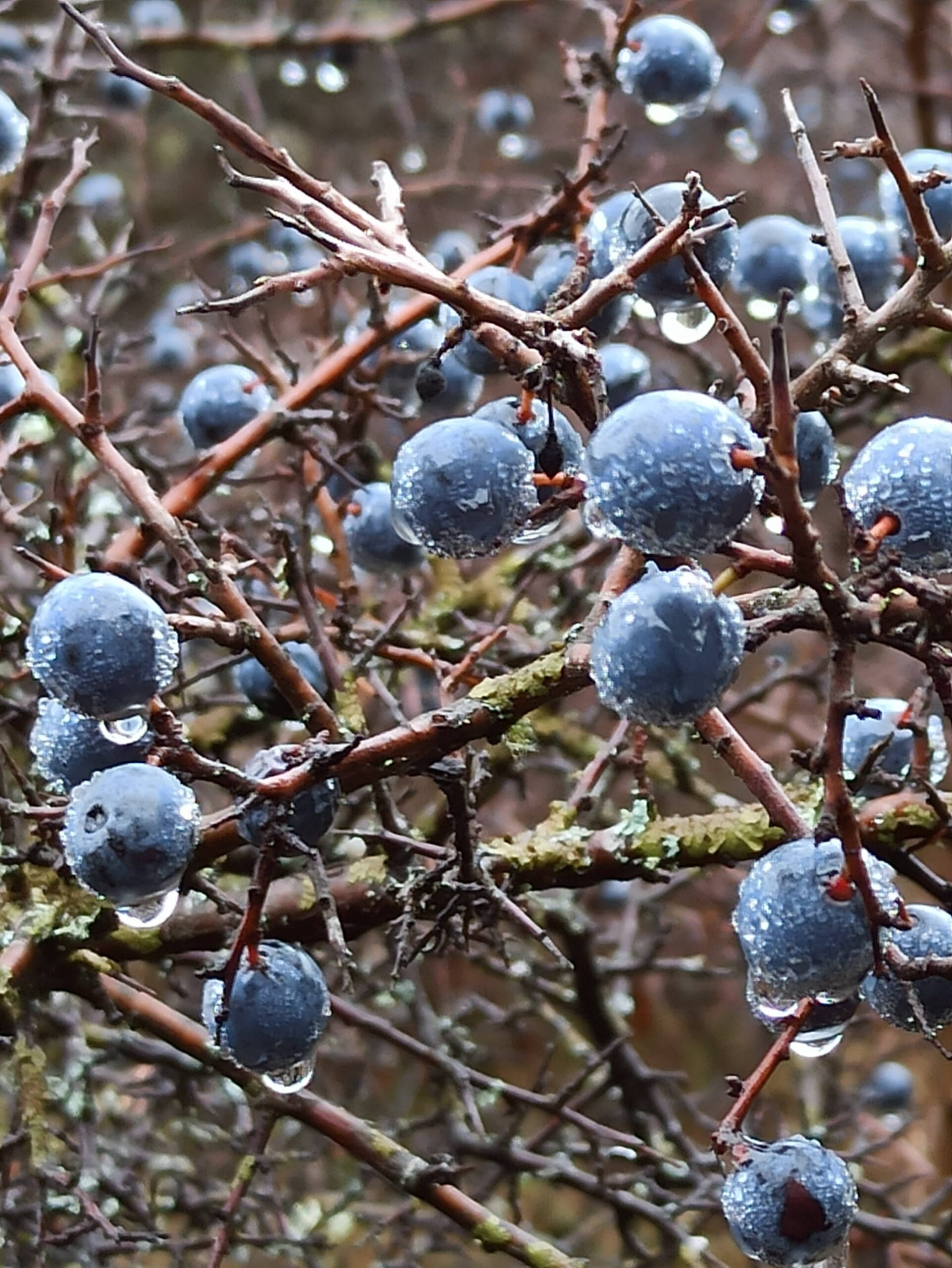
Today another hedgerow companion has been on my mind: Blackthorn and her special role in these dark winter months. A tree of protection for many of our wild birds, with her densely packed branches bearing redoubtable thorns, Blackthorn reveals herself most in Winter. To me she carries a message of Transformation.
Transformation is often imagined as illumination – a sudden awakening, a clear revelation, a moment when everything changes in an instant. Yet those who have lived through true metamorphosis know it rarely arrives in a flash of light. More often, it begins during the cold months of the soul, in hardship, in stillness, in the necessary descent into shadow.
Blackthorn (Prunus spinosa) is Winter’s sentinel and she teaches this deeper and more demanding truth: that Transformation is usually forged in darkness.
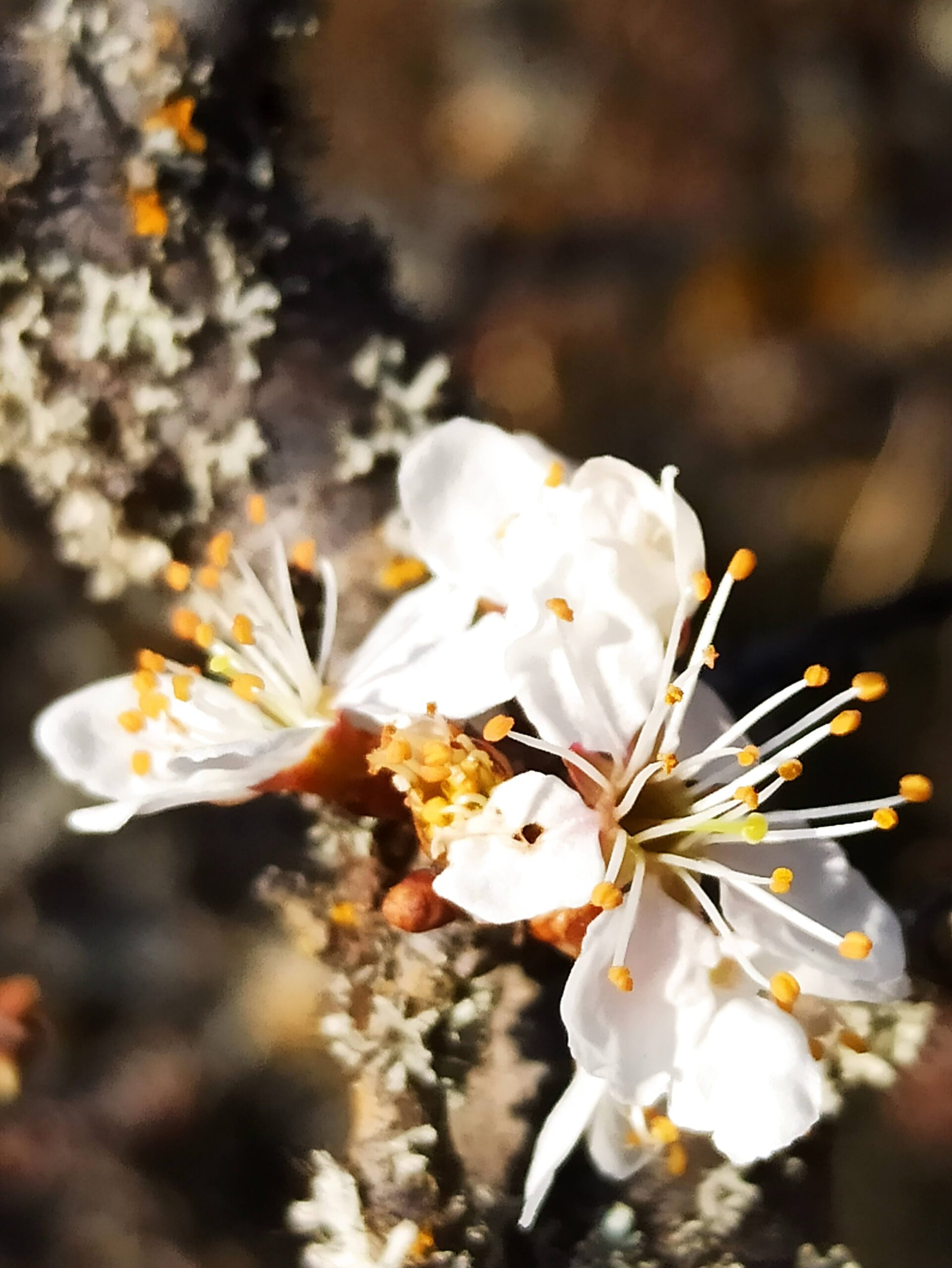
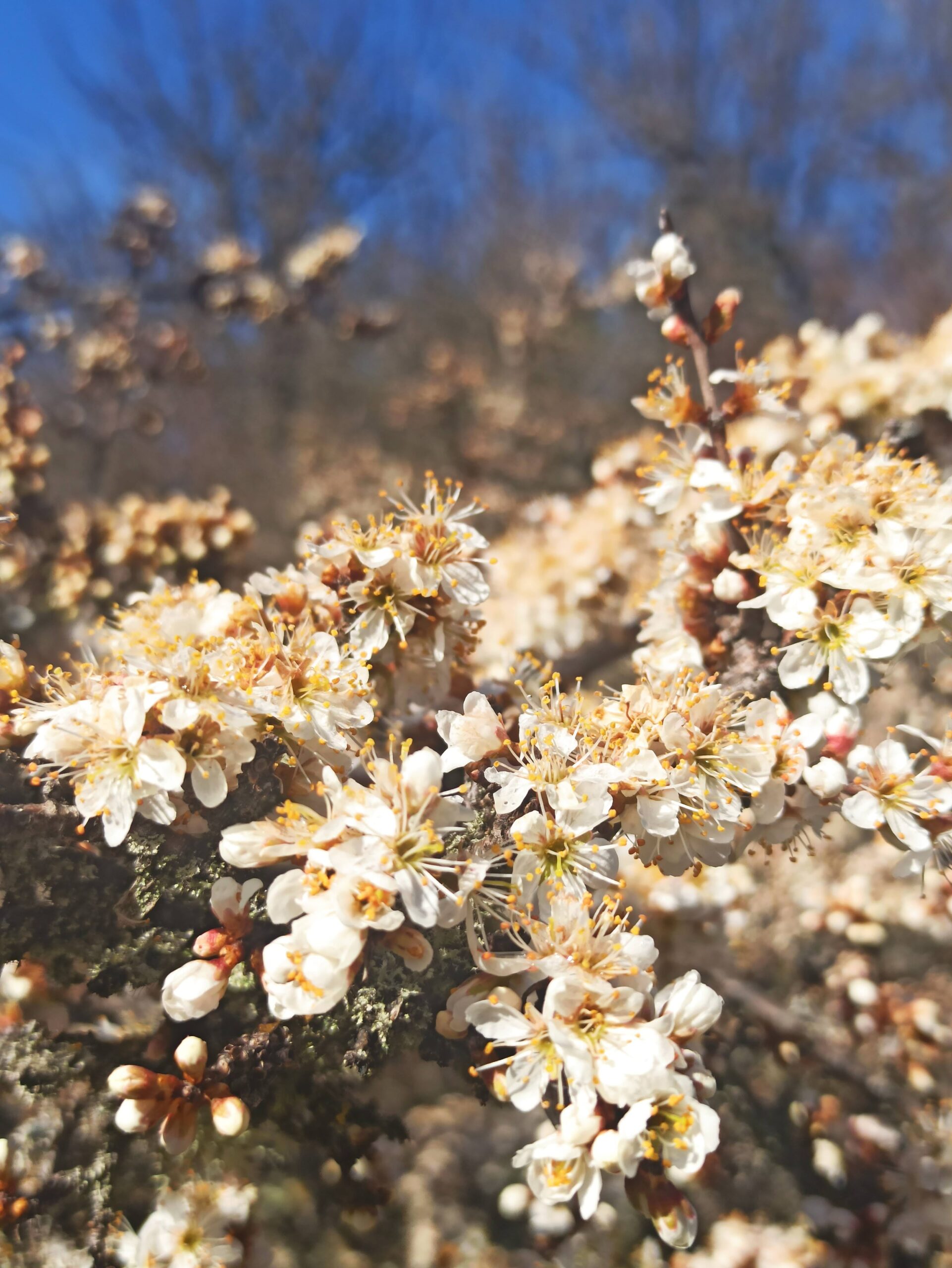
Blackthorn grows at the margins of old fields and ancient hedgerows, her dark branches weaving tight and formidable walls of thorn. In winter months she is stark and severe – a silhouette of endurance against the winter sky. And yet, in early spring, before her leaves have unfolded, she blossoms white upon dark wood, an extraordinary sight of luminosity breaking through austerity. This is her story of Transformation: what is renewed must first pass through a season of darkness, discipline and deep inner work.
In Celtic and Druidic traditions, Blackthorn belongs to the Crone, the wise woman of Winter – the one who knows the cycles of endings, thresholds, and rebirth. She is the dark sister of Whitethorn, also known as Hawthorn (the subject of a previous Musing), who presides over May’s abundance. Blackthorn governs the opposite pole of the year: Samhain through Imbolc, the cold, deep months when the earth contracts and life is condensed down to its very essence.
In Irish and Welsh lore, Blackthorn is a guardian. Her thorns are not symbols of malevolence but of protection, keeping inappropriate forces at bay. Blackthorn wands were traditionally used for banishing harmful influences, not out of fear or aggression, but as acts of spiritual clarity, the setting of firm boundaries in places where the veil is thin.
The Ogham letter aligned with Blackthorn is Straif, representing trials that refine the soul, the difficult initiations that deepen wisdom.
To receive Blackthorn’s teaching is to accept the invitation to walk willingly into one’s own shadow; not to be overwhelmed by it, but to understand it, honour it, be transformed by it and re-emerge fundamentally changed.
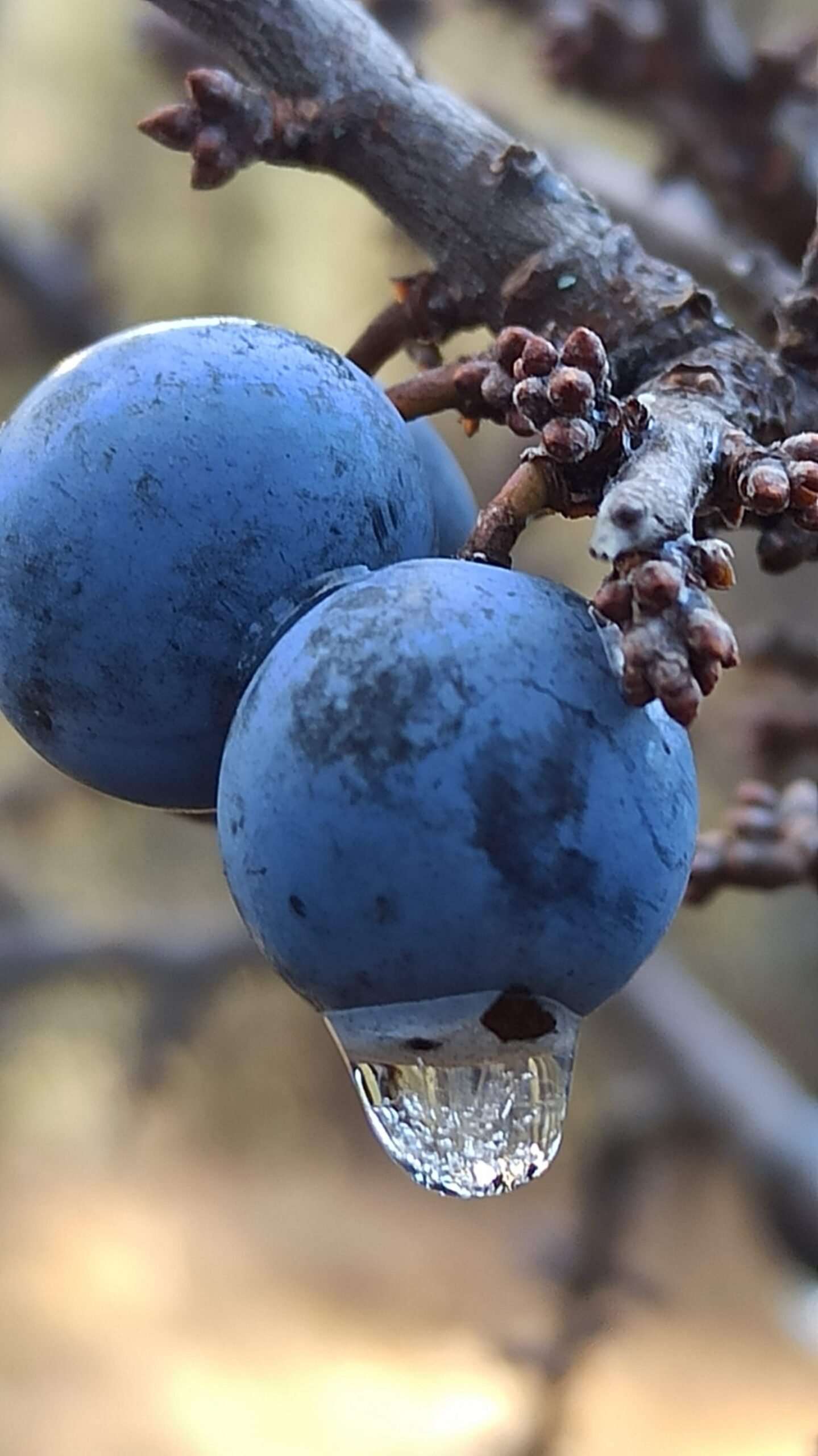
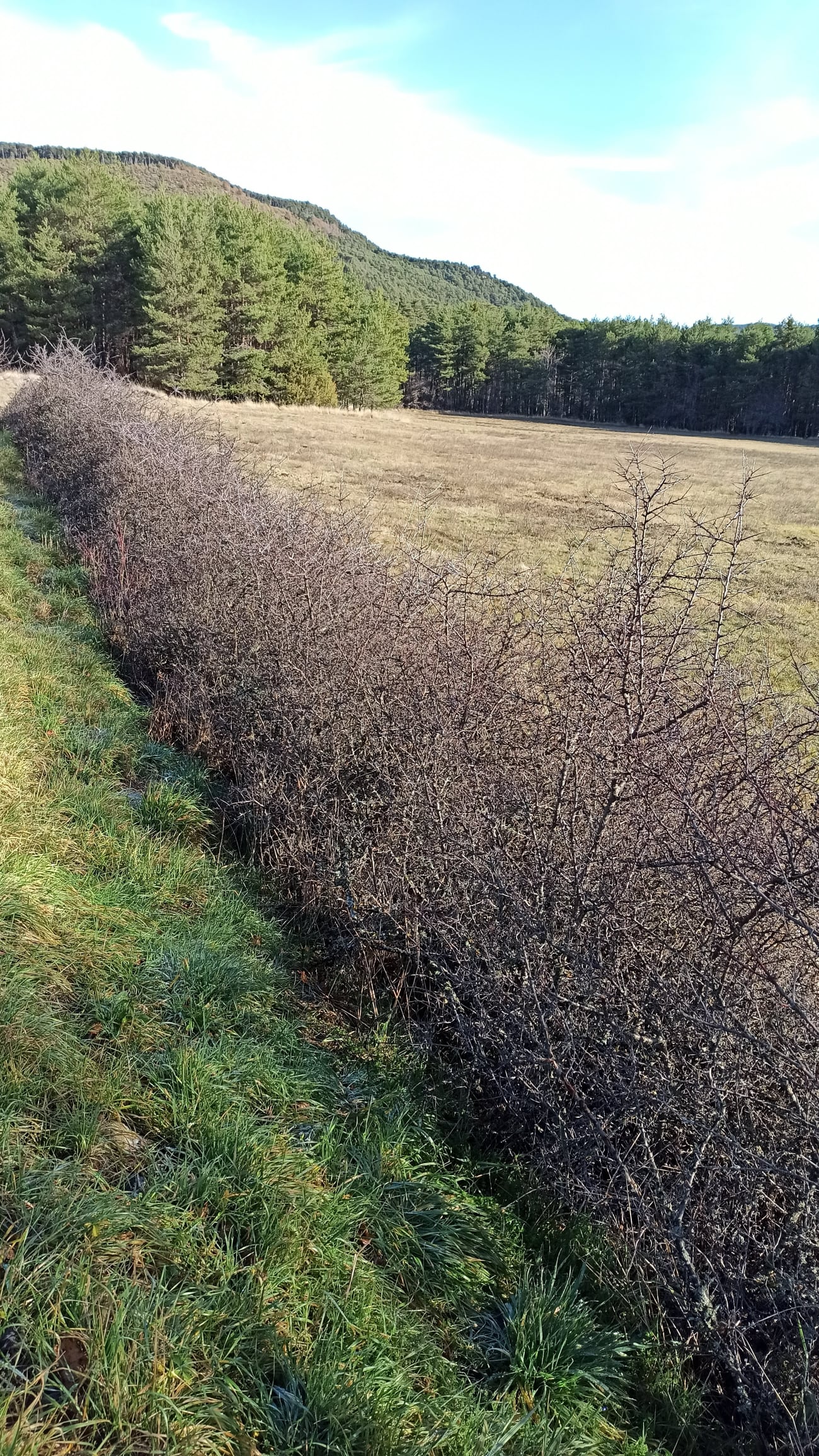
Blackthorn’s form is shaped by adversity. Her wood is dense and slow-growing, her roots anchored deeply into poor soils, her thorns formidable. She is a testament to endurance. Her power lies in her unflinching presence in the coldest months, when the landscape is stripped bare.
Her sloe berries/fruits, dark, astringent, and almost inedible when first formed, undergo an alchemy of their own. After the first frosts they begin to soften, their astringency is tempered and their flavour sweetens and deepens. Chemically speaking, sloes are rich in anthocyanins, tannins, and polyphenols; compounds associated with antioxidant action, vascular support, and cellular protection.
In the years when blackthorn sloes are abundant, I bow to the old English tradition of making sloe gin. Even this process is an alchemy – only 4 ingredients are needed: sloes, gin, sugar and patience. Over a minimum period of 2 months of maceration, the infused gin gradually transforms into a dark, delectable and ruby-red hued delight with similarities to an excellent aged porto, perfect for welcoming the winter solstice or the New Year.
Transformation is not the same as Transcendence. It asks us to make space for silence, to sit with the parts of ourselves that frighten or shame us, to acknowledge wounds we have long tried to outrun. Blackthorn stands as a companion in this shadowed terrain. Her presence is not gentle, but she is authentic and honest. She neither harms nor placates; she simply holds space with unwavering strength, allowing us to turn toward the difficult places within without dissolving.
Transformation requires courage, forgiveness, and a willingness to lay down the armour we have carried. It requires quiet spaces, both inner and outer, where truth and inner knowing can gently rise and be acknowledged. It often requires a “winter”: a period where nothing seems to move, yet everything is being quietly rearranged beneath the surface.
And then, just when winter feels the longest, Blackthorn does something astonishing. Before any leaves unfurl, before the world has fully warmed, she bursts into masses of white blossoms along her bare, dark branches.
These flowers are the public witness that you have endured the period of cold and dark and have emerged on the other side – transformed, lighter, resilient and hopeful.
What is more, if you look closely, Blackthorn’s flower buds were already mature right from the start of those hard and bleak times. They were just waiting for the right moment to bloom.
Without realising it, your capacity for Transformation was within you all along.


